
 Español
 Portugues
 Pусский
 Français
 Deutsch
 العربية
 Türk dili
 中文
中文 فارسی
فارسی
Industrial-Grade Food Cooling Machine
Industrial-Grade Food Cooling Machine An industrial-grade food cooling machine is a critical piece of equipment designed to rapidly reduce the temperature of cooked or processed food products to ensure food safety, extend shelf life, and maintain quality. These machines are widely used in food processing plants, commercial kitchens, and large-scale catering operations to meet stringent hygiene and efficiency standards. Key Features and Functionality 1. Rapid Cooling Technology Industrial food cooling machines utilize advanced cooling mechanisms such as blast chilling, vacuum cooling, or hydro-cooling to quickly lower the temperature of food from cooking levels (above 60°C/140°F) to safe storage temperatures (below 4°C/39°F). This rapid cooling prevents bacterial growth, particularly in the "danger zone" (5°C–60°C/41°F–140°F), ensuring compliance with food safety regulations. 2. High Capacity and Efficiency Designed for large-scale operations, these machines can handle substantial volumes of food, including liquids, solids, and semi-solid products. They feature powerful refrigeration systems with precise temperature control, allowing for uniform cooling without compromising texture or flavor. 3. Hygienic and Easy-to-Clean Design Constructed from food-grade stainless steel, industrial cooling machines resist corrosion and bacterial buildup. Smooth surfaces, removable components, and automated cleaning systems (CIP – Clean-in-Place) ensure compliance with sanitation standards like HACCP and FDA regulations. 4. Versatility in Applications These machines accommodate a wide range of food products, including meats, baked goods, dairy, sauces, and ready-to-eat meals. Some models offer adjustable cooling rates and multi-stage cooling to suit different product requirements. 5. Energy-Efficient Operation Modern cooling systems incorporate energy-saving technologies such as variable-speed compressors, heat recovery systems, and intelligent controls to minimize power consumption while maintaining optimal performance. 6. User-Friendly Controls Equipped with digital interfaces, programmable settings, and real-time monitoring, operators can easily adjust cooling parameters, track performance, and receive alerts for maintenance needs. Benefits - Enhanced Food Safety – Prevents spoilage and pathogen growth. - Improved Product Quality – Retains moisture, texture, and nutritional value. - Operational Efficiency – Reduces labor costs and processing time. - Regulatory Compliance – Meets international food safety standards. Applications - Meat and poultry processing - Bakery and confectionery cooling - Prepared meals and sous-vide products - Dairy and beverage cooling In summary, industrial-grade food cooling machines are indispensable in modern food production, combining speed, efficiency, and hygiene to ensure high-quality, safe food products. Their robust design and advanced technology make them a vital investment for any large-scale food processing facility.
Products
Category:
-
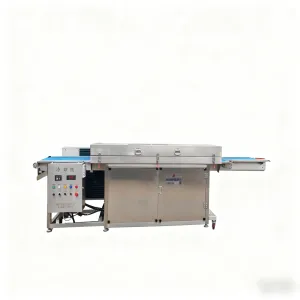
3-meter Industrial-Grade Food Cooling Machine
Category: Cooling MachineBrowse number: 48Number:Release time: 2025-11-11 10:01:41Industrial-grade food cooling machines are indispensable for modern commercial food processing, designed to rapidly and safely lower the temperature of freshly produced food—from baked goods and dairy products to cooked meats and prepared meals—while preserving quality, extending shelf life, and complying with strict global food safety standards (FDA, CE, ISO 22000). Crafted with food-grade stainless steel (304/316L) and precision cooling technologies (including air-blast cooling, water-jacket cooling, and vacuum cooling), these professional systems prevent bacterial growth (a critical risk in the “danger zone” of 5°C–60°C/41°F–140°F) and maintain food texture, flavor, and nutritional value—unlike ordinary cooling equipment that often causes uneven temperature drops or moisture loss. They offer customizable solutions for diverse sectors: bakery (cooling bread, pastries post-oven), dairy (chilling milk, yogurt to 2°C–4°C for storage), meat processing (cooling cooked sausages, ham to 0°C–4°C), and ready-to-eat (RTE) meal production (rapidly cooling pre-packaged dishes to avoid spoilage). Key advantages include high cooling efficiency (reducing temperatures from 80°C–100°C to 4°C in 30–60 minutes, depending on product type), energy-saving designs (equipped with heat exchangers and inverter compressors to cut 20%–30% energy costs), and user-friendly smart controls (PLC systems with touchscreens for real-time temperature monitoring, recipe storage, and fault alerts). Advanced models also integrate hygiene-focused features—smooth, crevice-free interiors for easy cleaning, CIP (Clean-in-Place) compatibility, and anti-corrosion coatings—to meet strict food hygiene requirements. As the food industry prioritizes traceability and sustainability, modern industrial food cooling machines further support green operations with refrigerant-free options (for eco-conscious brands) and data-logging functions (recording cooling cycles for audit compliance). Choosing the right industrial food cooling machine is more than a productivity investment—it safeguards product safety, reduces waste, and strengthens competitiveness in the fast-paced global food market, trusted by manufacturers worldwide for robust performance and reliable results across small-batch to large-scale production. -
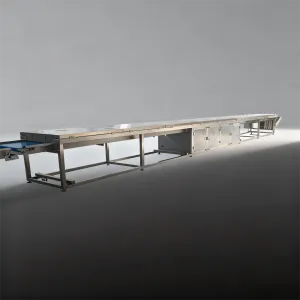
10m Food low-temperature cooling machine
Category: Cooling MachineBrowse number: 48Number:Release time: 2025-11-11 16:08:22A food low-temperature cooling machine is a vital asset for B2B food businesses—from processing plants and seafood facilities to bakeries and distribution centers—delivering precise sub-10°C cooling to preserve food quality, inhibit microbial growth, and extend shelf life. Unlike standard coolers, this specialized equipment operates at controlled low temperatures (typically -5°C to 8°C, adjustable for specific food types) to address the unique needs of perishables like raw meats, seafood, dairy, and pre-cooked meals, preventing spoilage and reducing waste in the supply chain. Equipped with advanced components such as energy-efficient compressors, food-grade stainless steel interiors, and intelligent temperature monitoring systems (with ±0.2°C accuracy), it ensures consistent cooling while complying with global food safety standards like HACCP, FDA, and EU 10/2011. Key benefits include rapid post-production cooling (slowing bacterial growth by up to 90% compared to ambient storage), preservation of nutritional value and flavor (avoiding texture degradation in sensitive foods like fruits or pastries), and compatibility with industrial workflows—whether integrated into production lines for continuous cooling or used in batch processing for small-scale operations. Designed for durability and ease of maintenance, food low-temperature cooling machines feature leak-proof insulation (reducing cold air loss and energy consumption by 25–30%), easy-to-clean surfaces (supporting hygiene protocols), and optional IoT connectivity for remote temperature tracking—critical for B2B clients managing multi-site facilities or seeking audit-ready data. Suitable for both indoor and semi-outdoor use (with weather-resistant designs for industrial yards), these machines come in customizable sizes, from compact countertop units for small cafes to large industrial systems for bulk food storage, making them indispensable for businesses prioritizing food safety, operational efficiency, and cost savings in low-temperature food management.
News
Category:
No search results found!
Case
Category:
No search results found!
Video
Category:
No search results found!
Download
Category:
No search results found!
Job
Category:
No search results found!
Featured Products
No search results found!



 WhatsApp
 Phone
Phone